The api 5l x70 psl2 specification represents the gold standard for high-strength pipeline steels used in the most demanding energy transport environments globally. As oil and gas exploration pushes into deeper waters and more volatile geological terrains, the need for materials that balance extreme yield strength with exceptional fracture toughness has become paramount for maintaining structural integrity and environmental safety.
Understanding the nuances of the api 5l x70 psl2 specification is not merely a technical requirement for engineers but a critical safety mandate. By adhering to Product Specification Level 2 (PSL2), manufacturers ensure more stringent testing requirements and mandatory toughness limits, which significantly reduce the risk of catastrophic pipeline failure in critical infrastructure projects across the globe.
From the sprawling pipelines of North America to the complex offshore networks in the North Sea, the implementation of the api 5l x70 psl2 specification enables the transportation of hydrocarbons under higher pressures while reducing the required wall thickness. This efficiency leads to lower material costs, reduced welding time, and a smaller overall environmental footprint during the construction phase of massive energy corridors.
In the current global energy landscape, the demand for efficient resource transmission is at an all-time high. The api 5l x70 psl2 specification has emerged as a pivotal standard that allows energy companies to operate pipelines at higher pressures without compromising safety. With the World Bank highlighting the need for sustainable infrastructure in developing nations, the adoption of high-grade steel like X70 ensures that new pipelines are built to last decades rather than years.
The challenge the industry faces is the "strength-toughness trade-off." Traditionally, increasing the strength of steel made it more brittle. However, the rigorous requirements of the api 5l x70 psl2 specification utilize advanced thermo-mechanical controlled processing (TMCP) to break this cycle, providing a material that can withstand both internal pressure and external environmental stresses, such as seismic activity or extreme temperature fluctuations.
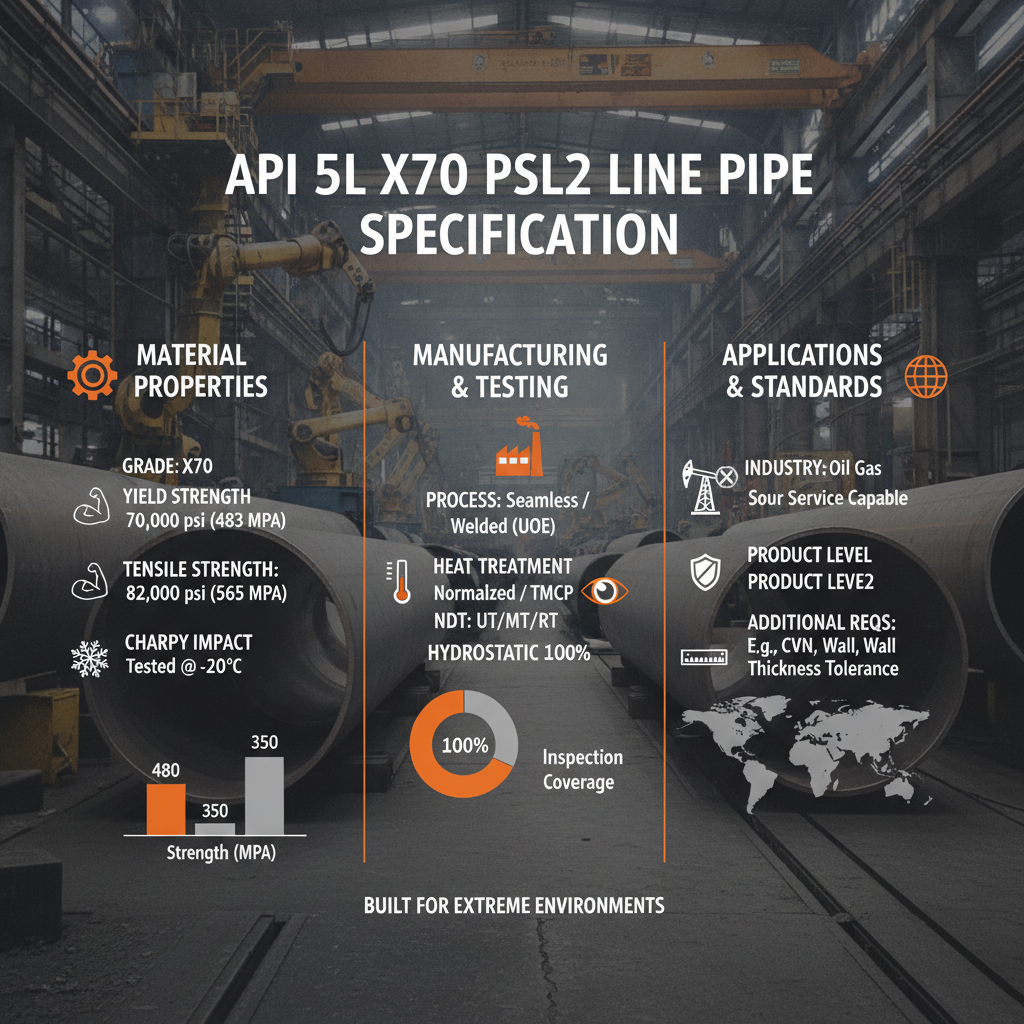
At its core, the api 5l x70 psl2 specification refers to a specific grade of line pipe steel. The "X70" indicates a minimum yield strength of 70,000 psi, while "PSL2" (Product Specification Level 2) denotes a higher quality tier than PSL1. While PSL1 is suitable for general use, PSL2 is mandatory for projects where strict chemical composition, mandatory toughness testing (such as Charpy V-notch), and weldability are non-negotiable.
This specification is more than just a list of numbers; it is a blueprint for reliability. By enforcing strict limits on carbon equivalents and impurity levels (like sulfur and phosphorus), the api 5l x70 psl2 specification ensures that the steel can be welded in the field without developing cracks, which is a primary concern in remote pipeline installations where conditions are far from ideal.
From a humanitarian and environmental perspective, this standard prevents leaks and spills. When a pipeline adheres to the api 5l x70 psl2 specification, the probability of a rupture due to brittle fracture is significantly lowered, protecting local ecosystems and ensuring the safe delivery of energy to millions of people in urban and rural zones.
One of the primary pillars of the api 5l x70 psl2 specification is its stringent chemical composition control. By meticulously balancing manganese, niobium, and vanadium, manufacturers can achieve a fine-grained microstructure that provides the necessary strength without sacrificing the ductility required for pipe bending and forming.
Toughness and Fracture Resistance are where the api 5l x70 psl2 specification truly diverges from lower standards. PSL2 requires mandatory impact testing at specific temperatures, ensuring that the steel does not transition into a brittle state in cold climates, which is essential for pipelines traversing Arctic or high-altitude regions.
Furthermore, weldability and scalability are integrated into the specification. The carbon equivalent (CE) values are tightly controlled to allow for high-efficiency welding processes, enabling the rapid assembly of thousands of kilometers of pipe while maintaining a consistent, high-strength joint that matches the parent metal's properties.
Evaluating the reliability of the api 5l x70 psl2 specification requires a look at its performance across various mechanical stressors. When compared to lower grades like X60 or X65, X70 provides a superior strength-to-weight ratio, which means less steel is needed to support the same internal pressure, leading to massive savings in logistics and material procurement.
Moreover, the PSL2 designation ensures that the variability between different batches of steel is minimized. This consistency is vital for automated welding systems used in modern pipeline construction, where any slight deviation in chemical composition could lead to weld defects and subsequent failure.
The practical application of the api 5l x70 psl2 specification is most evident in deep-water offshore projects. In regions like the Gulf of Mexico, where pipelines must withstand immense hydrostatic pressure and the corrosive nature of saltwater, X70 PSL2 provides the necessary wall strength to prevent collapse while remaining light enough to be installed by specialized vessels.
Additionally, in remote industrial zones such as the Siberian tundra or the Canadian oil sands, the toughness requirements of the PSL2 standard are lifesavers. By ensuring that the steel remains ductile at temperatures as low as -40°C, the api 5l x70 psl2 specification eliminates the risk of "cold-shortness," where pipes could snap like glass under sudden stress.
Investing in materials that meet the api 5l x70 psl2 specification offers substantial long-term economic value. Because the steel is stronger, operators can use thinner walls to achieve the same pressure rating, which reduces the total tonnage of steel required for a project. This not only lowers the initial procurement cost but also reduces the carbon footprint associated with steel production and transportation.
From a reliability standpoint, the "peace of mind" provided by PSL2 cannot be overstated. The rigorous testing and certification process creates a chain of trust between the mill, the contractor, and the end-user. Knowing that every joint and every section of pipe has been vetted against the strictest global standards reduces insurance premiums and lowers the long-term risk of environmental remediation costs.
Moreover, the scalability of these pipes allows for future-proofing. As energy demands grow, pipelines built to the api 5l x70 psl2 specification can often be upgraded to handle higher pressures through improved pumping stations, without needing to replace the physical infrastructure, thus extending the life cycle of the asset.
The evolution of the api 5l x70 psl2 specification is now moving toward the integration of "smart materials." We are seeing the development of X70 steels that are more resistant to Hydrogen-Induced Cracking (HIC), a critical development as the world transitions toward hydrogen as a clean energy carrier. The ability to repurpose existing natural gas pipelines for hydrogen transport depends entirely on the purity and strength standards established by specifications like X70 PSL2.
Digital transformation is also playing a role. The "Digital Twin" concept is being applied to pipes manufactured under the api 5l x70 psl2 specification, where every single pipe joint is tracked via a digital passport. This allows operators to know the exact heat number and chemical properties of a pipe at a specific GPS coordinate, making maintenance and leak detection far more precise.
Finally, the push for "Green Steel" is influencing the production of X70. By replacing blast furnaces with electric arc furnaces and using hydrogen instead of coke for reduction, the industry is working toward a version of the api 5l x70 psl2 specification that is not only technically superior but also carbon-neutral.
| Application Environment | Key Requirement | X70 PSL2 Performance | Risk Mitigation Level |
|---|---|---|---|
| Deepwater Offshore | Collapse Resistance | Excellent | High |
| Arctic Tundra | Low Temp Toughness | Superior | Critical |
| High-Pressure Gas | Yield Strength | Optimal (70ksi) | High |
| Seismic Zones | Ductility/Plasticity | Very Good | Medium-High |
| Hydrogen Transition | HIC Resistance | Good (with Mod) | Medium |
| Urban Corridors | Leak Prevention | Exceptional | Maximum |
The primary difference lies in the rigor of testing and chemical control. PSL2 requires mandatory toughness testing (Charpy V-notch) and has stricter limits on chemical composition (such as phosphorus and sulfur) to ensure superior weldability and fracture resistance. While PSL1 is acceptable for low-risk environments, PSL2 is the industry standard for critical infrastructure where failure could have catastrophic environmental or safety consequences.
Yes, but with considerations. Standard X70 PSL2 provides the strength necessary for hydrogen, but hydrogen can cause embrittlement in some steels. Modern iterations of the specification often include additional controls to minimize "Hydrogen-Induced Cracking" (HIC). It is recommended to specify "HIC-resistant" X70 PSL2 for pure hydrogen or high-blend hydrogen projects to ensure long-term structural integrity.
While the per-ton cost of PSL2 steel is higher than PSL1 due to stricter quality control, it often reduces the overall project cost. Because X70 has a higher yield strength, engineers can specify a thinner wall thickness for the same pressure rating. This reduces the total weight of steel purchased, lowers shipping costs, and accelerates welding speeds, resulting in a lower total cost of ownership.
Mandatory tests include chemical analysis of every heat, mechanical property tests (yield and tensile strength), and mandatory impact testing to verify notch toughness. Additionally, non-destructive testing (NDT) such as ultrasonic or hydrostatic testing is required to ensure the pipe is free of internal defects and can withstand its rated operating pressure without leaking.
Yes, the API 5L standard is the most widely recognized pipeline specification in the world. Whether a project is in Asia, Europe, or the Americas, X70 PSL2 is accepted as a benchmark for high-strength line pipe. This global harmonization allows companies to source material from certified mills worldwide while maintaining a consistent safety and quality level across different continents.
The X70 grade is typically achieved through Thermo-Mechanical Controlled Processing (TMCP). This involves precise control of the rolling temperature and the cooling rate after rolling. By manipulating the microstructure to create very fine grains and utilizing micro-alloying elements like niobium and vanadium, manufacturers can reach the 70,000 psi yield strength without needing excessive carbon, which keeps the steel weldable.
The api 5l x70 psl2 specification stands as a cornerstone of modern energy infrastructure, bridging the gap between extreme mechanical performance and uncompromising safety. By integrating stringent chemical controls, mandatory toughness testing, and advanced manufacturing processes, it provides a reliable solution for the world's most challenging pipeline environments—from the frozen Arctic to the deep ocean floor.
Looking forward, the adoption of this specification will be critical as the industry pivots toward the hydrogen economy and sustainable steel production. For engineers and procurement managers, adhering to the PSL2 standard is not just a regulatory checkbox but a strategic investment in the longevity, safety, and environmental stewardship of their assets. To explore high-quality pipeline solutions that meet these rigorous standards, visit our website: www.benkoometal.com
If you are interested in our products, you can choose to leave your information here, and we will be in touch with you shortly.