Comprehensive Guide to API 5L Spec: Standards for Line Pipe
In the world of oil and gas transportation, the integrity of pipelines is non-negotiable. The api 5l spec provides the global benchmark for the manufacture of line pipe, ensuring that materials can withstand extreme pressures, corrosive environments, and varying temperatures. Whether you are managing a large-scale infrastructure project or sourcing materials for a refinery, understanding the nuances of this specification is critical for safety and longevity. This guide breaks down the technical requirements and selection criteria of the API 5L standard to help you make informed procurement decisions.
What Exactly is the API 5L Spec?
The api 5l spec is a technical standard published by the American Petroleum Institute (API) that specifies the requirements for the manufacture of line pipe for the conveyance of oil, gas, and water. It covers everything from the chemical composition and mechanical properties to the manufacturing processes and testing procedures. By adhering to this spec, manufacturers ensure that the steel pipes are uniform in quality, which is essential for welding and joining in the field. The standard is divided into different product specification levels (PSL 1 and PSL 2) to accommodate different risk levels and environmental conditions.
Understanding Product Specification Levels (PSL)
One of the most critical aspects of the api 5l spec is the distinction between PSL 1 and PSL 2. PSL 1 is the standard grade typically used for less demanding environments. In contrast, PSL 2 is more stringent, requiring mandatory fracture toughness testing and stricter chemical limits to prevent brittle failure. For high-pressure pipelines or those crossing environmentally sensitive areas, PSL 2 is the industry requirement to ensure maximum reliability and safety against catastrophic leaks.
Quick Tip: Always specify the PSL level during the RFQ process. Choosing PSL 2 when PSL 1 suffices increases costs, but choosing PSL 1 for high-stress applications can lead to structural failure.
Comparing API 5L Grades and Properties
The api 5l spec defines various grades (such as B, X42, X52, X60, X65, X70, and X80) based on their minimum yield strength. The "X" grades denote high-strength steel, where the number represents the minimum yield strength in 1,000 psi. Selecting the correct grade involves balancing the need for high pressure resistance with the necessity of weldability and ductility. As the grade increases, the steel becomes stronger but can become more challenging to weld without specialized procedures.
Manufacturing Processes Under API 5L
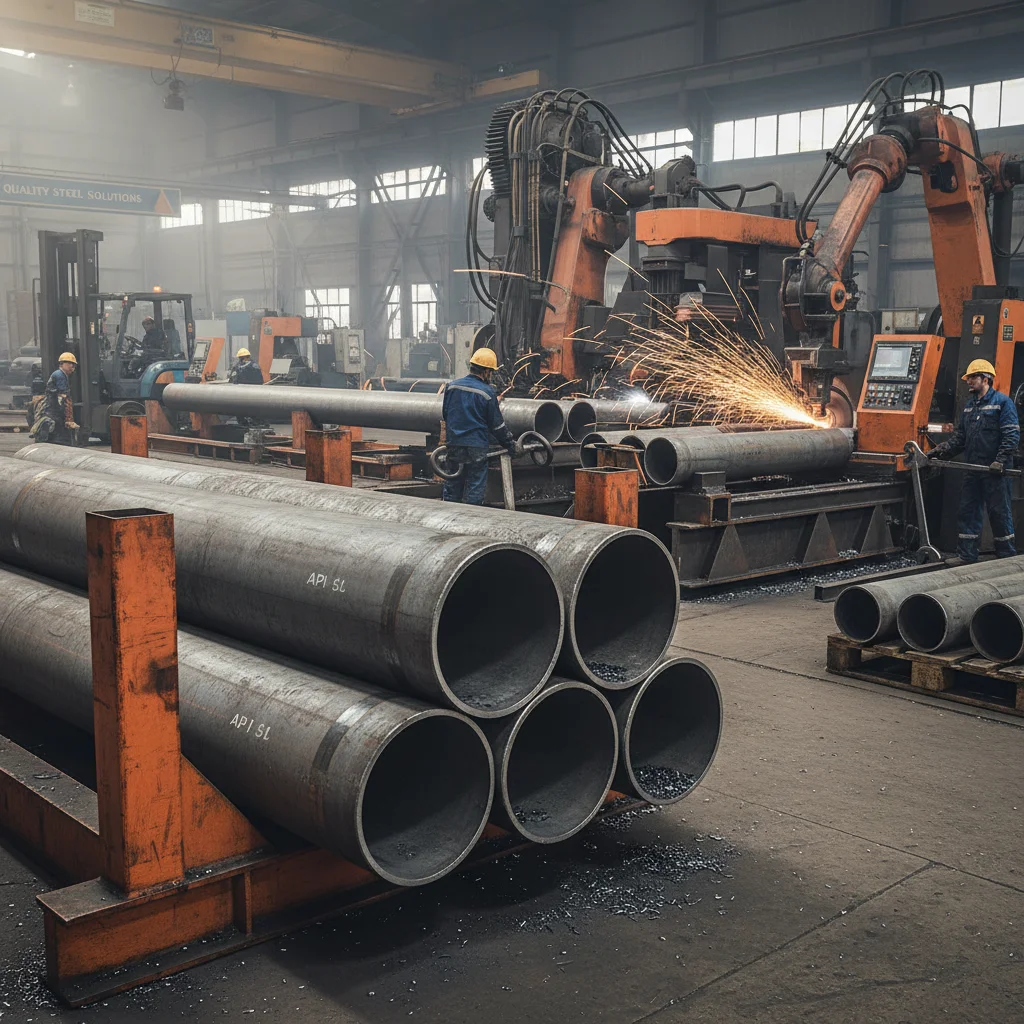
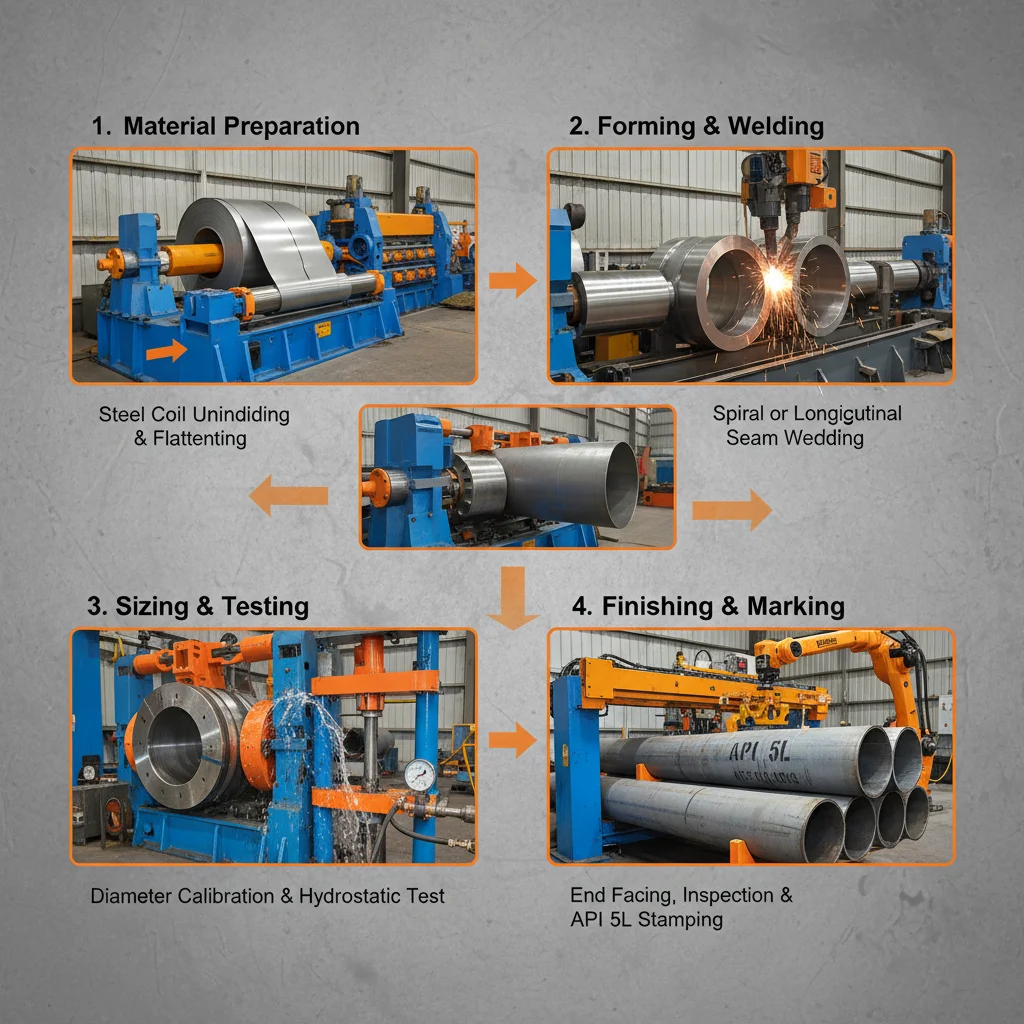
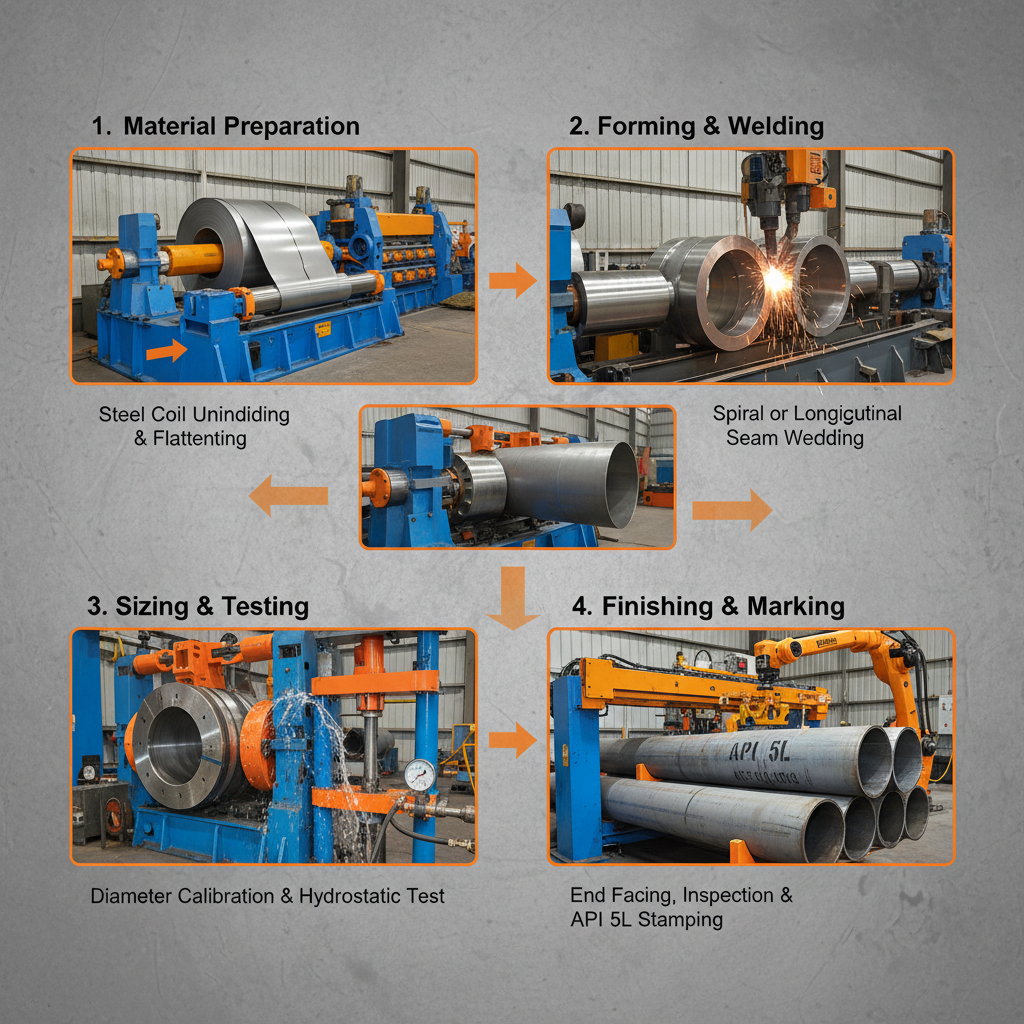
The api 5l spec allows for several manufacturing methods, each suited for different diameters and wall thicknesses. Seamless (SMLS) pipes are produced by piercing a solid billet, making them ideal for high-pressure applications where a weld seam could be a point of failure. Electric Resistance Welded (ERW) and Longitudinal Submerged Arc Welded (LSAW) pipes are formed from steel plates or coils. LSAW is particularly useful for large-diameter pipes used in cross-country transmission. Each method undergoes rigorous Non-Destructive Testing (NDT) to ensure no defects exist in the pipe wall.
Quality Control and Testing Requirements
To certify a pipe under the api 5l spec, a battery of tests is required. Hydrostatic testing is the most common, where the pipe is filled with water and pressurized beyond its operational limit to check for leaks. Chemical analysis verifies the carbon equivalent (CE) to ensure the steel is weldable. For PSL 2 pipes, Charpy V-notch impact tests are conducted to measure the material's toughness at low temperatures, preventing brittle fracture in cold climates. These quality controls guarantee that the pipeline will not fail under environmental or operational stress.
Technical Specifications Table
When sourcing pipes, it is helpful to have a summarized view of the technical boundaries. The following table outlines the general specifications associated with the most commonly ordered api 5l spec products.
Conclusion: Ensuring Pipeline Integrity with API 5L
Selecting the right pipe based on the api 5l spec is a critical engineering decision that impacts the safety, cost, and lifespan of any energy project. From choosing between PSL 1 and PSL 2 to selecting the appropriate X-grade for pressure requirements, every detail matters. By partnering with a supplier that understands these rigorous standards, you can ensure your infrastructure is built to last. For high-quality, certified line pipes that meet every aspect of the API 5L standard, trust in professional expertise to safeguard your operations.
Frequently Asked Questions (FAQs)
What is the difference between API 5L PSL 1 and PSL 2?
The primary difference lies in the stringency of the requirements. PSL 1 is the basic specification level, focusing on standard chemical and mechanical properties. PSL 2 is a more rigorous level that includes mandatory requirements for chemical composition (stricter limits on carbon and sulfur), mandatory fracture toughness testing (Charpy V-notch), and stricter weld quality controls. PSL 2 is essential for projects where the risk of failure is high or where the environment is extreme, such as offshore platforms or Arctic regions.
How do I choose the correct grade (e.g., X52 vs X70)?
Choosing the grade depends on the operating pressure of the pipeline. Higher grades like X70 have a higher yield strength, allowing for thinner pipe walls to handle the same pressure, which reduces the total weight and material cost. However, higher strength steels often require more precise welding procedures to avoid cracking. You should calculate the maximum allowable operating pressure (MAOP) and consider the environmental conditions before selecting a grade from the api 5l spec list.
Can API 5L pipes be used for water transport?
Yes, API 5L pipes are widely used for water transportation, including municipal water lines and industrial cooling systems. While the specification was originally designed for oil and gas, the mechanical strength and durability make it excellent for water. However, because water can be corrosive, it is highly recommended to apply an external and internal coating (such as Fusion Bonded Epoxy or 3LPE) to prevent rust and extend the life of the pipeline.
What are the common NDT methods used for API 5L pipes?
Non-Destructive Testing (NDT) is vital for ensuring there are no hidden flaws. Common methods include Ultrasonic Testing (UT) to check for wall thickness and internal voids, Radiographic Testing (X-ray) to inspect the integrity of the weld seams in ERW or LSAW pipes, and Magnetic Particle Inspection (MPI) to find surface cracks. These tests ensure that every meter of pipe delivered to the site meets the rigorous safety criteria defined in the api 5l spec.


-20251218091502.webp "Steel Solid Bars")
-20251219054209.webp "Titanium Plate & Sheet")
-20251218093108.webp "Steel Plates")
-20251219052202.webp "Titanium Seamless Pipes")